

The Backpack Is Packed. What About the Pressure Underneath It?
Back-to-school prep usually stops at supplies and schedules. Here is why the emotional side of the transition needs its own spot on the list.
Read More
back to schoolanxiety

The first week back is harder than the first day, and nobody warns you. Here is what is behind the one-word answers and the after-school crash, and why connection beats a perfect routine right now.
The first day went fine. You got the photo, the backpack, the brave little wave at the door. Then somewhere around day three your kid came out of school, told you it was fine, and fell apart before you reached the stop sign. Nobody really warns you that week one is the hard part, not day one.
Your child spent seven hours holding it together in a room where the rules were new and the teacher's expectations were still a mystery. That takes everything they have. By the time they get to you there is nothing left in the tank, and you get the crash.
Therapists call it restraint collapse. It is worth knowing the name, mostly so you stop reading it as misbehaviour or as some verdict on your parenting. Kids fall apart in front of the person they feel safest with. You get it precisely because the teacher did not.
The behaviour you see at pickup is the bill for the self-control your child spent all day at school.
The one-word answers come from the same place. When you ask about the day and get "fine," that is usually not stonewalling. Most kids cannot summarize seven hours of new information on demand while running on empty. The talking comes later and sideways, in the car or at the sink, when nobody has to make eye contact.
And then there is you. You have your own version of this week going: forms you have not signed, an email from the teacher sitting unanswered, a low background hum that every other family has this sorted. Kids read that off us faster than we would like. This is the week to get the paper pile off your mental to-do list rather than carrying it around, and KinClub's Family Records was built for exactly that. Snap a photo of the field-trip form or the letter from school and it gets filed with a title, a date and a category, so it stops taking up room in your head.
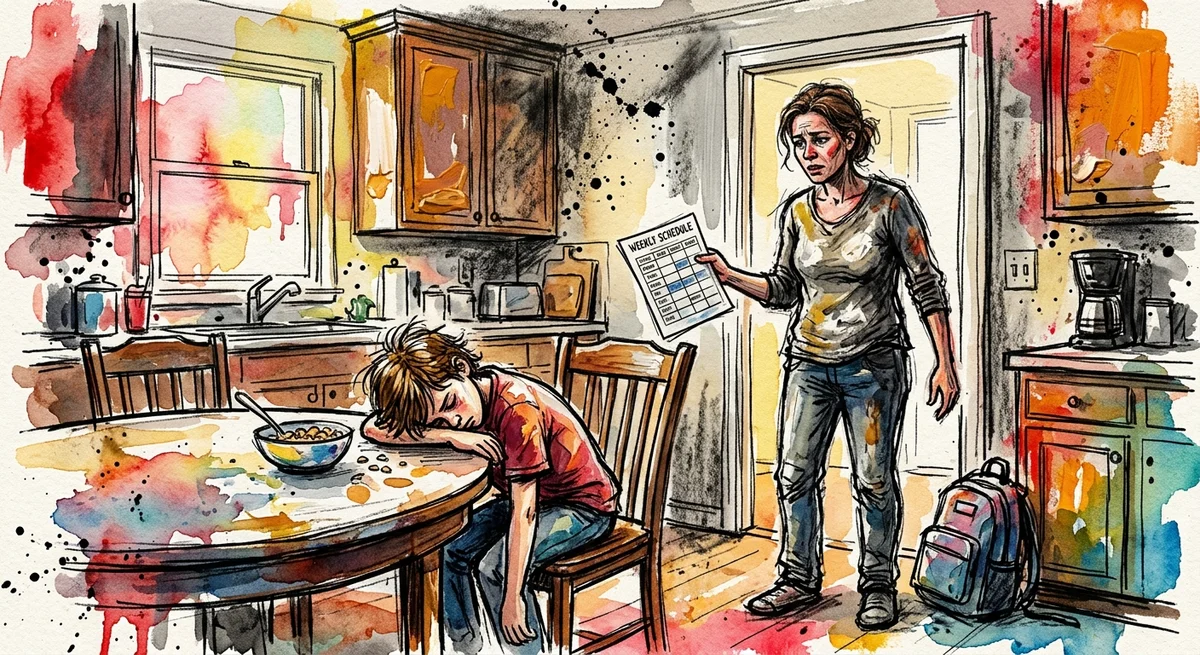
The instinct in week one is to tighten everything up. Fix the mornings, finally get the chart working. I understand the impulse and I think it is mostly the wrong week for it. A kid this depleted cannot take on a new system, but they can take your company.
That last one is where most families get their footing back, and it does not have to be ambitious.
None of this fixes the week. What it does is make sure your kid is not getting through it alone, which turns out to be most of what helps.
Two watches on school anxiety and staying connected through a rough patch:
Week one is not an exam you either pass or fail. It is a run of hard days that get gradually less hard, and the thing your kid needs most is evidence that you are steady while they get through them.
Back-to-school prep usually stops at supplies and schedules. Here is why the emotional side of the transition needs its own spot on the list.

If your child falls apart every Friday afternoon, they are not being difficult. They are exhausted. Here is what a low-demand weekend looks like.
Why kids push back on routines they used to accept, and how to rebuild using connection anchors instead of enforcement.