
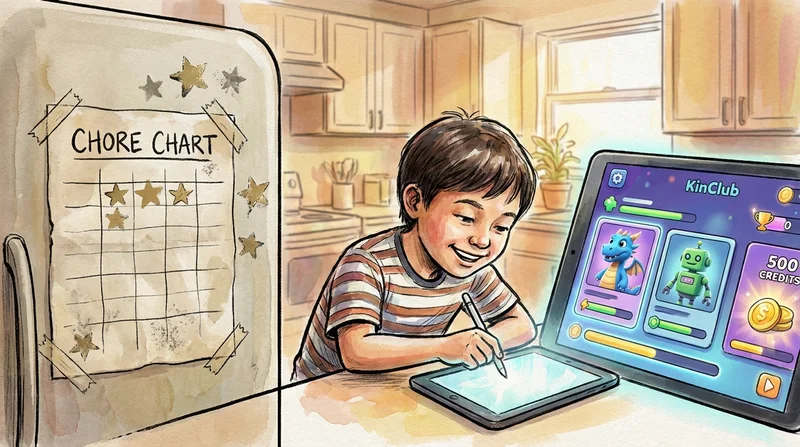
The Great Chore Debate: Nurturing Motivation Without the Meltdowns
Explore the science of intrinsic vs. extrinsic motivation and discover how to transform your kids from helpers to contributors using gamified systems.
Read More
parentingmotivation

Struggling to get your kids to sit down and focus on homework? These warm, practical strategies will help you build routines that stick and motivation that comes from within.
It is 4pm. Your child has been home for an hour. The backpack is still by the door. Homework has not been mentioned. And you are bracing yourself for the negotiation — or the meltdown — that is about to begin.
If this sounds familiar, you are absolutely not alone. Getting kids to tackle homework is one of the most common daily struggles parents face, and it rarely gets easier by simply asking harder. The good news is that there are genuine, research-backed strategies that can shift the dynamic — not by forcing compliance, but by building the kind of routine and inner motivation that makes homework feel like a normal part of the day rather than a punishment.
This post walks you through practical, tested approaches you can start using this week.
Before we can fix the problem, it helps to understand it. Kids are not being difficult for the sake of it. After six or more hours of sitting, concentrating, and following instructions at school, most children are genuinely depleted when they get home. Their brains and bodies need a break.
When we ask them to immediately pivot back into focused cognitive work, we are essentially asking a sprinter to run another race the moment they cross the finish line.
Play is not a luxury. It is a necessity. Children need unstructured downtime to consolidate learning and restore their capacity for attention.
Understanding this does not mean letting homework slide — it means timing and context matter enormously. A child who has had 30–45 minutes to decompress, move their body, and have a snack is a completely different homework partner than a child pulled straight off the school bus.
The single most powerful thing you can do for homework is establish a consistent routine — and do it before any conflict arises. Routines reduce decision fatigue for everyone. When homework happens at the same time, in the same place, every day, it stops being a negotiation and starts being just what we do after school.
Here is what a solid homework routine looks like in practice:
The four-part after-school sequence:
The key is consistency over perfection. Even if the timing shifts slightly day to day, the sequence being predictable is what trains the brain to expect it.
Where your child does homework matters as much as when. The environment sends powerful signals about what mode we are in.
What makes a good homework space:
Some children focus better with a parent nearby; others do better with privacy. Pay attention to what your child actually needs rather than what seems logical. And if the kitchen table is where homework happens best, that is completely fine — it does not need to be a separate desk.
When homework becomes a battle, the instinct is often to reach for rewards: "Finish your homework and you can have screen time." And while external rewards can work in the short term, research consistently shows they can actually undermine long-term motivation if overused — particularly for tasks the child might otherwise find interesting.
This is called the overjustification effect: when we attach a big reward to an activity, children begin to see the activity itself as not worth doing unless there is a payoff.
A better approach is to build intrinsic motivation — the internal drive that comes from feeling capable, autonomous, and connected to a purpose.
Three ways to support intrinsic motivation:
1. Give them some control Let your child choose the order they tackle their assignments. This small act of autonomy makes a real difference. "Do you want to start with maths or reading tonight?" removes the feeling of being directed and replaces it with agency.
2. Focus on effort, not results Praise the process rather than the outcome. "You kept going even when that problem was tricky" builds a growth mindset. "You are so smart" can actually make kids more afraid to fail.
3. Connect homework to meaning For older children especially, linking schoolwork to things they care about makes a difference. A child who loves animals might find biology homework much easier to engage with if you draw a connection to what they are passionate about.
Every child is different, and so is every homework battle. Here are targeted strategies for the most common situations:
"I don't know how to do it" This often masks anxiety rather than genuine confusion. Sit beside them, read the instructions together, and break the task into the smallest possible first step. Starting is often the hardest part — once they have written one sentence or solved one problem, momentum builds.
"It's boring" Acknowledge it. "Yeah, I get it — copying out spellings is not very exciting." Validation takes the wind out of resistance. Then try a small challenge: "Can you get three done in two minutes?" Gamifying a dull task can shift the energy entirely.
"I'll do it later" Later rarely comes. If your child is a chronic delayer, the fix is structure — not nagging. The routine does the work for you. When homework happens at the same time every day, "later" is not really an option anymore because it is already accounted for.
"It's too hard" This is worth taking seriously. If your child is consistently finding homework overwhelming, it may signal a gap worth exploring with their teacher. In the meantime, break tasks into chunks with short breaks in between (the Pomodoro technique — 10 minutes on, 5 minutes off — works brilliantly for primary-aged children).
"You never help me" There is a difference between helping and doing. Your job is to be a supportive presence, not to complete the work. Ask guiding questions: "What do you think the first step is?" rather than providing the answer. This keeps them in the driver's seat while knowing you are alongside them.
One of the most important skills as a homework parent is knowing where your role ends. Children need to experience the natural consequence of not doing homework — whether that is a conversation with their teacher or a lower grade — if they are going to build genuine responsibility.
This does not mean being cold or unsupportive. It means trusting that your child is capable of handling the consequences of their choices, with your warm guidance in the background.
Some nights, it will not go smoothly. There will be tears, a slammed book, a forgotten assignment. This is normal — it does not mean your routine has failed or that you are doing it wrong.
What matters is that you return to the routine the next day without drama. Consistency over time is what creates lasting change, not any single perfect evening.
Be kind to yourself in this. You are doing something genuinely hard — helping a tired, developing brain build a habit that will serve them for the rest of their life. That is worth something, even on the messy days.
Homework does not have to be the nightly battle it so often becomes. With the right routine, the right environment, and a shift away from pressure and towards autonomy, most children can move from resistance to something approaching acceptance — and occasionally even pride in getting it done.
Start small. Pick one thing from this post to try this week. Maybe it is moving homework 30 minutes later to allow for a proper break. Maybe it is letting your child choose their task order. Small shifts, applied consistently, add up to real change.
And on the hard nights — breathe. You have got this.
Explore the science of intrinsic vs. extrinsic motivation and discover how to transform your kids from helpers to contributors using gamified systems.
Learn the difference between natural and logical consequences, why they work better than punishment, and how to use both approaches to raise resilient, self-aware kids.

Explores the powerful influence of parental behaviour on children and offers practical advice for modelling the habits you want to see in your kids.