Celebrating Spins and Special Interests: Why Leaning Into Your Child's Intense Passions Is the Ultimate Bonding Tool
For neurodivergent kids, a "spin" or hyperfixation is not a problem to manage — it is a superpower waiting to be shared. Here is how leaning in to your child's intense passions builds trust, self-esteem, and the deepest kind of connection.
Your child has been talking about the same subject for forty-five minutes straight. Roman aqueducts. Minecraft redstone circuits. The complete filmography of Studio Ghibli. The migratory patterns of humpback whales. You have nodded along, asked questions you did not fully understand, and quietly wondered: is this too much?
Here is what the research — and the lived experience of thousands of neurodivergent families — says clearly: no, it is not too much. It is exactly enough.
For many children, especially those who are autistic or have ADHD, intense passions go by many names. Special interests. Spins. Hyperfixations. Obsessions (a word we are going to retire today). Whatever you call them, these deep, consuming fascinations are not a red flag. They are one of the most meaningful windows into who your child truly is — and leaning into them may be the single most powerful thing you can do to strengthen your relationship.
This post is about why these passions matter, what they do for your child, and how you can use them as a bridge to the kind of connection that lasts a lifetime.
The term special interest is most commonly associated with autism, where it appears in diagnostic criteria — though framed, unhelpfully, as a deficit. Hyperfixation is the term often used in the ADHD community, describing periods of laser-focused absorption in a topic or activity. Many families simply call them spins — a warm, playful shorthand for when your child's brain starts spinning on something and cannot stop.
The neurology behind this is worth understanding. Neurodivergent brains often have differences in how dopamine is regulated and released. For autistic individuals, special interests activate the brain's reward system in a profound way — providing pleasure, relief from sensory overload, and a sense of mastery and control in a world that can feel chaotic and unpredictable. For children with ADHD, hyperfixation taps into the same dopamine pathway: when something is genuinely captivating, the attention system lights up in a way that ordinary tasks simply cannot achieve.
In short, your child is not being difficult or obsessive. Their brain has found something that works — something that makes them feel calm, competent, and alive.
The special interest is not a symptom to be treated. It is a communication. It tells you everything about what the child values, how they think, and what brings them joy.
It is easy to see intensity as a warning sign, especially in a culture that prizes balance and moderation. But for neurodivergent kids, intensity is often where their greatest gifts live.
Consider what a deep special interest actually builds:
Expertise and genuine mastery — children who hyperfixate often develop knowledge that rivals adults
A regulated nervous system — the interest is frequently a self-soothing tool that reduces anxiety and overwhelm
Identity and self-concept — knowing something deeply and loving it wholeheartedly is core to a strong sense of self
Social currency — shared interests are the foundation of almost every meaningful friendship
Intrinsic motivation and persistence — skills learned through passion transfer to other domains over time
Future pathways — many neurodivergent adults build careers directly from childhood special interests
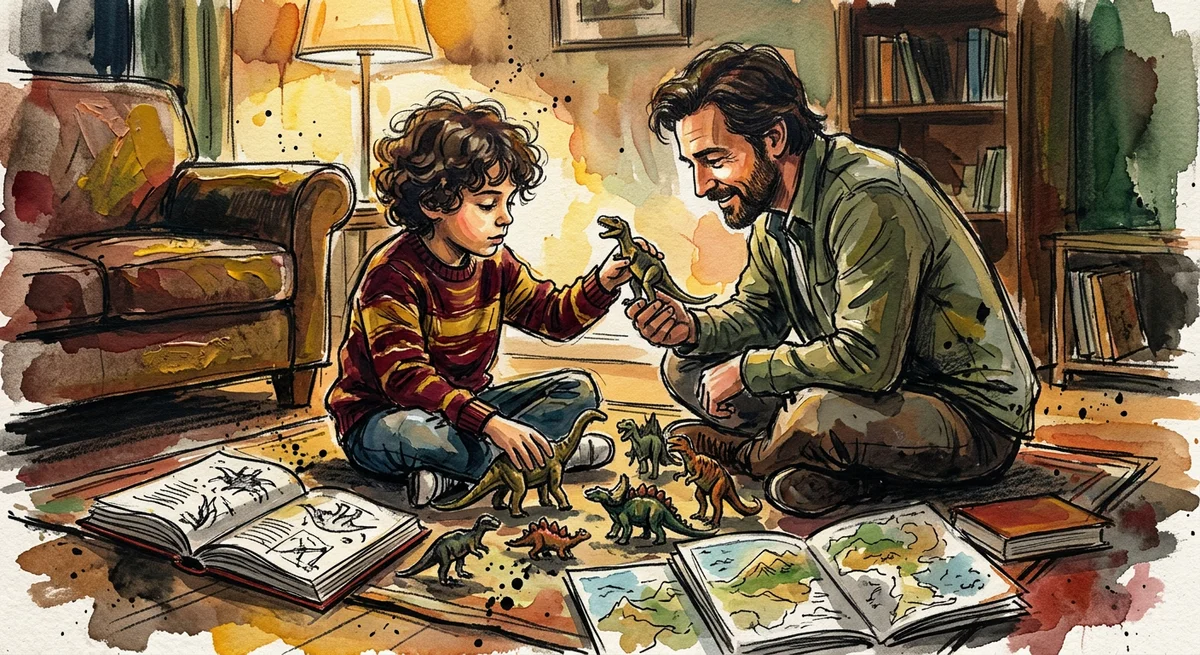
The child who knows every dinosaur species by its Latin name is building a scientist. The child who can recite every line of a favourite film is building a writer, a director, a cultural analyst. The child who has memorised every train timetable in the country is building an engineer or a logistics expert. The passion is the seed. Your job, as the parent, is not to prune it — it is to water it.
Many parents of neurodivergent children describe a quiet ache: the sense that they love their child fiercely but struggle to truly reach them. Conversations feel effortful. Eye contact is rare. Shared activities feel forced. The child seems most alive in their own world, and you are standing at the door wondering how to be let in.
Special interests are the door.
When a parent genuinely engages with a child's spin — not in a performative, teeth-gritted way, but with real curiosity — something shifts. The child experiences something they may rarely feel: I am interesting. My mind is worth being in. This person wants to be here.
That is not a small thing. For a neurodivergent child who may have spent years feeling misunderstood, corrected, or implicitly told that their way of experiencing the world is wrong, a parent saying "tell me more" about the thing they love most is an act of profound validation.
On KinClub: User Rooms lets every member of your family customise their own profile page — pinning their favourite interests, showcasing what they love, and making their corner of KinClub genuinely their own. For a child with a strong special interest, setting up their Room together can be a meaningful way to say: your passions deserve to take up space. Try it at kin-club.com
Leaning in does not mean becoming an expert overnight or pretending to love something you do not. It means showing up with genuine curiosity and a willingness to follow your child's lead. Here is how.
Ask to be taught. Position yourself as the student. "Can you explain to me how that works?" or "I want to understand this — where should I start?" This is deeply honouring. It signals that their knowledge has value and that you respect them as a source of expertise.
Join the world, not just the conversation. If your child loves trains, visit a railway museum. If they love volcanoes, watch a documentary together and let them correct the narrator (they will). If they love a particular video game, ask for a tutorial. Showing up physically inside the interest sends a message words cannot.
Find the bridge topics. Every special interest connects outward to the broader world. Dinosaurs connect to geology, evolution, and ecology. Minecraft connects to architecture, engineering, and mathematics. Anime connects to Japanese culture, storytelling, and visual art. Help your child find those bridges, and you help them find their place in the world.
Celebrate the monologues. When your child launches into a detailed explanation, resist the urge to redirect. Listen. Ask one follow-up question. Let them finish. The monologue is trust — they are sharing the thing that matters most to them. That deserves to land.
Share it with the wider family. Encourage grandparents, aunts, uncles, and siblings to ask about the interest too. A child who has multiple safe people who know about their spin feels more seen and less alone.
On KinClub: The Family Calendar makes it easy to schedule dedicated time for what matters — including regular one-on-one sessions built around your child's current spin. Blocking out even thirty minutes a week sends a clear message: this interest is important enough to put on the calendar. Try it at kin-club.com
One of the harder parts of raising a child with intense passions is navigating the world outside your home. Other children may not share the interest. Teachers may find it disruptive. Relatives may worry it is "too much" or express concern that the child should be talking about something else.
Here are a few principles that help.
You do not have to defend your child's passion — but you should protect it. You do not owe extended family a long explanation of neurodivergence. A simple "she loves this, and we love that she loves it" is enough. What matters is that your child knows their home is a safe place for their full self.
Help them read the room, gently. Part of growing up is learning that not every conversation partner wants a forty-minute deep dive. This is not a reason to shame the interest — it is an opportunity to help your child build social awareness. "I love hearing all of this. In situations like this one, we might want to give people a shorter version first and then see if they want to hear more. Want to practise?"
Connect them to their community. One of the greatest gifts of the internet age is that almost every niche passion has a community. Finding age-appropriate forums, YouTube channels, clubs, or local groups of children who share the same interest can be transformative. Neurodivergent children who find their people — even one or two — often experience a significant shift in self-esteem and social confidence.
The world needs all kinds of minds. The child who thinks differently is not broken. They see things the rest of us miss.
There is a deeper truth underneath all of this. When you celebrate your child's spin, you are not just celebrating a topic. You are celebrating them — their particular way of experiencing joy, their capacity for depth, their unique mind.
For neurodivergent children who may spend much of their day being asked to mask, conform, and regulate themselves to fit neurotypical expectations, home should be the place where the mask comes off. The spin is often the most unmasked, authentic expression of who they are. When you meet it with warmth, you meet them with warmth.
Research consistently shows that parental acceptance — not just tolerance, but genuine celebration of a child's authentic self — is one of the strongest predictors of long-term mental health outcomes for neurodivergent individuals. The stakes are real. And so is the reward.
Your child's spin is not a detour from connection — it is the road. It is an invitation, issued in the only language that feels completely safe to them, to come inside and know them.
You do not have to become an expert in every topic they love. You do not have to pretend enthusiasm you do not feel. But if you can bring genuine curiosity, a willingness to listen, and the consistent message that their passions are worthy of your time and attention — you are giving them something that matters far beyond childhood.
You are telling them: who you are is not a problem. Who you are is wonderful.
And that is the foundation everything else is built on.
We're passionate about helping families find a healthy balance with technology. Our team creates content on healthy screen time, educational tech, and building strong family connections in the digital age.