

You Are Not Bad at Routines. You Just Start Over Every Morning.
Why families keep restarting routines instead of building them, and how to make one habit stick.
Read More
routines
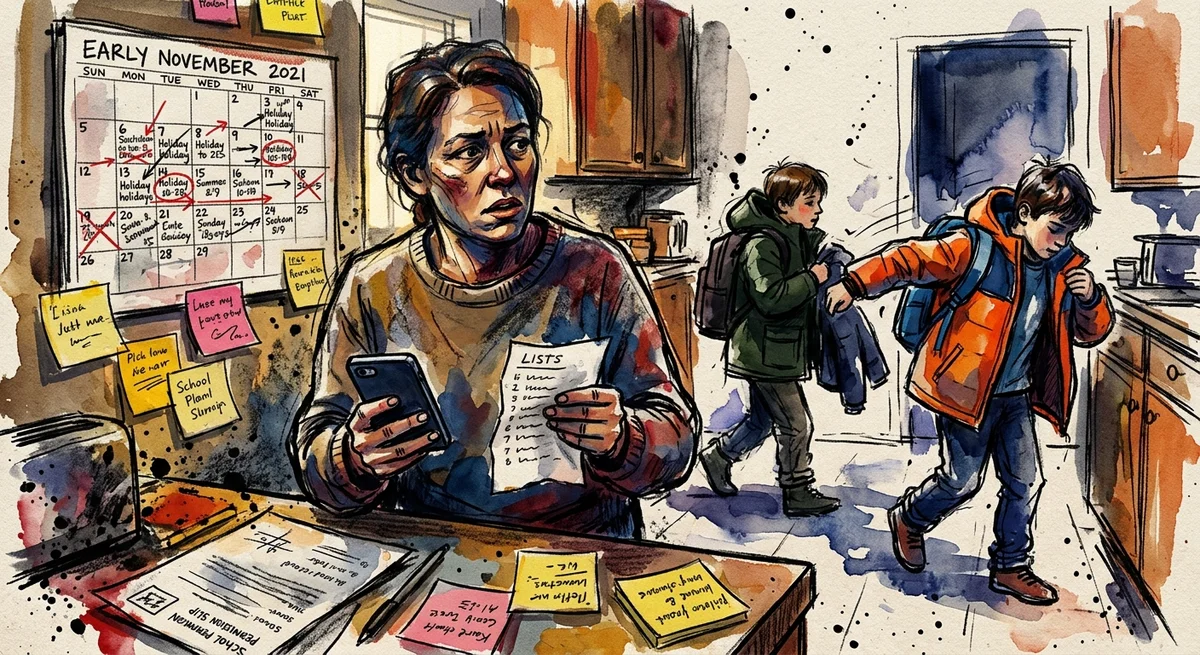
The early dismissal is in an email, the travel dates are in a group text, and the chore list fell behind the toaster. Here is why the mental load is really a lookup problem, and what changes when your calendar, chores, and family chat finally live together.
It is the second week of November and you are carrying four pieces of information that do not live anywhere near each other. The early dismissal came in a school email. The Thanksgiving travel dates are buried in a group text. Whose turn it is to drag the recycling out was on a sticky note that fell behind the toaster in September. And the thing your partner told you on Tuesday is nowhere at all.
You are not disorganized. Your family is spread across nine different places, and your brain is the only index.
When parents describe feeling buried, they usually blame the amount of stuff. Fair enough, some weeks there is genuinely too much. But the thing that grinds you down is quieter than that. Every question turns into a search.
Is practice canceled this week? Check the text thread, then the league app, then give up and ask another parent. Did the permission slip get signed? Check the backpack, the email, the counter. Who has the car on Friday?
Ten seconds. Maybe thirty. You do forty of them a day, and all forty route through you, because you are the only person in the house who knows which app holds which answer. People call that the mental load, which makes it sound like a weight. It behaves more like a job: you have been quietly working as the family search engine.
November makes it louder. The holidays bring a second set of logistics that sits on top of the first one without replacing any of it. School concert, travel dates, who is hosting, the gift list, the week with no school. The regular Tuesday still happens underneath all of it.
Adding a better app for each category has not worked, and it was never going to. What helps is having fewer places to look.
Put your calendar, your chores, and your family conversation in one place and the first thing you notice is that people stop asking you. Your ten-year-old can check whether there is practice. Your partner sees that the dentist moved without you forwarding a thing.
The second is that context stops drifting away from the event it belongs to. A message about the early dismissal sits beside the calendar entry for the early dismissal, so nobody has to remember that those two facts are related.
Then there is the one parents do not expect. Household work becomes visible. A chore sitting in your head is invisible by definition, so of course nobody volunteers for it. Move it onto the shared calendar with a name and a day attached and the whole family can see that someone has to do it. That lands better than any speech about pitching in.
Do not try to migrate your whole life on a Sunday afternoon. Start small enough that it can prove itself by Friday.
If you want a soft landing, start with forwarding. Anything that arrives as a text or a WhatsApp message can go straight into KinClub the same way you would send it to a relative, and it gets filed for you. No retyping, no deciding where it belongs.
November has a way of exposing whichever system you have been getting away with since August. Pick one place, put the next two weeks into it, and let your brain stop being the index.
Why families keep restarting routines instead of building them, and how to make one habit stick.

What a packed activity calendar costs a family, and how to claim connection back.

Why pre-holiday buildup shows up as behavior, and how to add structure early.